Key points at a glance
- Equity: Banks usually finance no more than 80% of the lending value. You provide at least 10% without money from the pension fund (2nd pillar).
- Affordability: With an imputed interest rate of 5%, 1% maintenance and amortisation, housing costs must not exceed around one third of gross income.
- Purchase costs: from under 1% to around 4.5% of the purchase price, depending on the canton. You pay them on top, from your own funds.
- Interest rates: The SNB policy rate is 0% (confirmed on 24 September 2026). The best 10-year fixed-rate mortgages cost around 1.5 to 1.7% at the end of September; the average was around 2%.
- Taxes: From 1 January 2029, the imputed rental value (Eigenmietwert), the debt interest deduction and the maintenance deduction for owner-occupied property will be abolished. First-time buyers get a temporary deduction.
- Contract: Only the notarised purchase contract is binding. Since 1 January 2026, you have 60 days to notify defects in a property you have bought.
- Location: Kitchen and heating can be replaced. Winter sun, noise and natural hazards stay. Check them before you make an offer.
The process in ten steps
Whether it’s a single-family house or a condominium flat, the order is almost always the same.
- Clarify your budgetAdd up your equity and calculate affordability. A meeting with a bank or broker shows which mortgage is realistic. Go to the calculator
- Get a financing confirmationSellers and estate agents often ask for one before they accept an offer. For this, the bank needs your salary certificate (Lohnausweis), tax return, pension statements and proof of equity.
- SearchProperty portals and search alerts, estate agents, new-build projects, offers outside the portals and auctions published in the Swiss Official Gazette of Commerce (SOGC).
- Check the location before you viewWinter sun, noise at night, natural hazards, the building zone next door and your daily journeys. You can do this with the official maps or all in one place in the SunPlot report. Check the location
- View and request documentsAt least twice and at different times of day, the second time with an expert. Also ask for the land register extract (Grundbuchauszug), plans and building permits, and for condominium ownership (Stockwerkeigentum) the regulations and minutes as well. Checklist
- Make an offerBids are not binding until notarisation. A reservation without notarisation does not oblige you to buy, and as a rule you can reclaim a reservation payment. More on this
- Take out a mortgageGet three to five offers on the same day, choose the model and terms, and arrange the bank’s payment undertaking. Models
- Notarise the purchase contractCheck the notary’s draft early: price, handover date, warranty, tenancies and the securing of the property gains tax.
- Land register entry and paymentYou become the owner when you are entered in the land register (Grundbuch). The bank pays the purchase price concurrently with the application to the land registry office.
- Handover and notice of defectsDraw up a handover report with meter readings. Notify defects within 60 days, and hidden defects within 60 days of discovering them.
The market in autumn 2026
Prices. The Federal Statistical Office’s residential property price index was 3.5% higher in the second quarter of 2026 than a year earlier. Most recently, it was mainly condominium flats that rose (+1.6% on the previous quarter), while single-family houses eased slightly (−0.4%). Supply remains tight: on 1 June 2026, only 0.93% of all dwellings were vacant.
Interest rates. The Swiss National Bank left its policy rate at 0% on 24 September 2026. Long-term fixed-rate mortgages have nevertheless become slightly more expensive since July because capital market rates have risen. Forecasts differ. ZKB expects a policy rate of 0.75% within twelve months, UBS an increase to 0.5% by June 2027 (both as of 24 September 2026).
Buying or renting. According to UBS, the running costs of home ownership are on average 24% below the rent for a comparable property (March 2026). Access remains difficult, however. A household with a median income can finance a good 100 m² condominium flat in only 17% of municipalities (UBS, May 2026). If you have a long-standing, low rent, you are often better off renting, according to ZKB (July 2026).
Financing: equity and affordability
Whether you can buy is decided by the bank with two tests. Do you have enough equity? And can you still bear the costs if interest rates rise significantly?
Equity: 20%, of which at least 10% “hard”
As a rule, banks finance no more than 80% of the lending value. You provide the rest yourself. The guidelines of the Swiss Bankers Association (SBA), recognised by FINMA as a minimum standard, require that at least 10% of the lending value does not come from the 2nd pillar. The 80% limit is bank practice. Above it, banks must hold significantly more capital of their own under the Capital Adequacy Ordinance.
Counts as hard
- Savings and securities
- Pillar 3a, withdrawn or pledged
- Surrender values of life insurance policies
- Advance on inheritance and gifts
- Loans that are subordinated or assigned to the bank
Does not count as hard
- Early withdrawal or pledging from the pension fund
- Vested benefits (Freizügigkeitsguthaben)
Since 2025, for owner-occupied property, loans from a partner, parents, grandparents, siblings and adult children and grandchildren also count. The condition is that the lender confirms to the bank in writing that they will only demand repayment with the bank’s consent. However, interest and instalments on such loans weigh on affordability, and bank practice varies.
Lowest-value principle: the bank calculates with the lower value
The lending value (Belehnungswert) is the lower of the purchase price and the bank’s valuation. If you pay more than the bank’s valuation, you cover the entire difference with hard equity.
Affordability: around one third of income
The bank calculates with an imputed interest rate that is far above today’s. This is how it checks whether you could still pay if interest rates were higher.
| Item | Usual assumption |
|---|---|
| Imputed (notional) interest rate | 5% of the mortgage, 4.5% at some banks |
| Maintenance and ancillary costs | 1% of the purchase price or market value, sometimes 0.7 to 1% |
| Amortisation | the portion above ⅔ of the lending value, spread over no more than 15 years |
| Limit | around ⅓ of sustainable gross income |
These values are not set out in any law. Each bank sets them itself. In May 2025, FINMA cited as an example 33% of gross income, 5% interest and 0.8% ancillary costs for properties in as-new condition. At the same time, it urged the banks to consistently flag exceptions to affordability as such.
Only sustainable income is taken into account. Bonuses often count only in part. A second income usually only counts if both people are jointly and severally liable for the mortgage. Leasing, loans and maintenance payments are deducted. For the period after retirement, the bank calculates with the pension.
Amortisation: the second mortgage within 15 years
You repay the portion of the mortgage above two thirds of the lending value in equal instalments within no more than 15 years, starting no later than twelve months after the payout. Many banks also require this portion to be repaid by retirement. Each bank decides itself where the second mortgage begins, mostly at 65 to 67%.
- Direct: You pay off the debt. The debt and the interest go down.
- Indirect: You pay into a pledged pillar 3a. The mortgage stays the same. The contributions are tax-deductible, and until the end of 2028 so is the debt interest. From 2029, the debt interest deduction for owner-occupied property no longer applies.
In the example above, amortisation is CHF 8,889 per year. That is more than the maximum pillar 3a contribution of CHF 7,258 per person (2026).
Money from the pension fund and pillar 3a
You can withdraw your pension fund assets early or pledge them for owner-occupied residential property. They do not count towards the hard 10%.
| Early withdrawal | Pledging | |
|---|---|---|
| What happens | The pension fund pays directly to the seller or lender. | The assets remain in the fund and secure the mortgage. |
| Taxes | Immediately, as a capital benefit, separately from other income and at a lower rate. You pay the tax from other funds. | None, as long as the pledge is not realised. |
| Consequences | Lower retirement benefits and often lower risk benefits too. Voluntary buy-ins to the fund only after repayment. | Your benefits remain the same. In return, the mortgage is higher and you pay more interest. |
| Rules | Possible up to three years before you become entitled to retirement benefits. From age 50, at most the higher of your assets at age 50 and half of your current assets. Married people need their spouse’s written consent. | |
For an early withdrawal: at least CHF 20,000, at most every five years, paid out no later than six months after the application. A restriction on disposal is noted in the land register. If you sell, you must repay the money. If you plan a new purchase within two years, you can temporarily transfer the amount to a vested benefits account. If you repay, you get back the tax paid, without interest, provided you apply within three years.
Pillar 3a. A withdrawal for buying, building or amortisation is possible every five years and is taxed as a capital benefit. Money from pillar 3a counts as hard equity. New: you can make up contribution gaps, for the first time in 2026 for the year 2025, and at most ten years back. Gaps from years before 2025 cannot be made up. You need earned income in Switzerland that is subject to AHV contributions, both in the year of the gap and in the year you make it up. In that year, you must also pay the full regular contribution. You can pay in at most CHF 7,258 extra per year (2026). Once you have drawn the retirement benefit from pillar 3a, this is no longer possible.
Buying together
- Co-ownership (Miteigentum): Each person owns a share, for example half each, and can sell or pledge it. The others have a right of first refusal.
- Joint ownership (Gesamteigentum): only through a community such as the marital property regime or a simple partnership. Decisions must be unanimous.
- Pension money: If you use money from the pension fund or pillar 3a, joint ownership is only possible for married couples and registered partners. Unmarried couples choose co-ownership.
- Liability: For the mortgage, each person is usually liable for the full amount, regardless of their share.
- Unmarried couples: There is no statutory right of inheritance. A will, an agreement between the partners and term life insurance protect the other person.
Documents for the bank
Affordability calculator
The calculator uses the banks’ usual assumptions. An example has already been entered. Change the figures and the result adjusts immediately.
Affordability
30.8% of gross income
Simplified calculation based on common bank practice, not an offer. The calculator deducts the purchase costs from the funds outside the pension fund, because the pension fund pays directly to the seller or the bank. Here, the second mortgage starts at ⅔ of the lending value. All results are without guarantee. They are intended as initial guidance and are no substitute for advice from a bank, notary or expert.
Choosing a mortgage: models and interest rates
| Model | How it works | Suits you if |
|---|---|---|
| Fixed-rate mortgage | Fixed interest rate, usually for 2 to 15 years. Getting out early costs an early repayment penalty. | you want predictable costs and fear rising interest rates |
| SARON mortgage | SARON plus a fixed margin, charged monthly or quarterly. Many banks set SARON at a minimum of 0%. Usually a framework agreement over several years. | you can cope with fluctuations. Today you effectively only pay the margin. |
| Variable mortgage | No fixed term, usually terminable at six months’ notice. Considerably more expensive: an average of 2.79% in July 2026. | you only need to bridge a short period |
| Forward mortgage | Locks in a fixed rate for a start in up to 12 or 24 months, for a surcharge. | an existing mortgage expires soon |
Interest rates at the end of September 2026
| Term | Best offers | Average |
|---|---|---|
| SARON mortgage (margin) | from 0.64% | around 1.0 to 1.1% |
| 5-year fixed-rate mortgage | around 1.4 to 1.6% | around 1.8% |
| 10-year fixed-rate mortgage | around 1.5 to 1.7% | around 2.0 to 2.1% |
Sources: MoneyPark and Helvetia (21 September 2026), RealAdvisor (24 September 2026), hypotheke.ch (23 and 25 September 2026), SNB interest rate statistics (July 2026). Rates change daily. The banks’ indicative rates are often 0.4 to 0.5 percentage points above what you can negotiate.
How to compare offers
- Get three to five binding offers on the same day, with the same key data.
- Compare banks, insurers, pension funds and brokers. At the end of September 2026, insurers and pension funds in some cases offered the lowest rates for 5 and 10 years.
- Besides the interest rate, also compare fees, amortisation rules, switching between models and the rules on the early repayment penalty.
- For a SARON mortgage, negotiate the margin. It applies for the entire term of the contract.
- Staggering terms spreads the interest rate risk. However, a new bank usually won’t take over a single tranche while the others are still running. That ties you to your existing bank.
Early repayment penalty. If you terminate a fixed-rate mortgage before it expires, the bank charges the lost interest. Roughly: amount times remaining term times the difference between the contract rate and the current rate for the remaining term. If rates have risen since you took out the mortgage, the penalty is low or disappears altogether. Some banks even credit you something. The contract governs this.
Purchase costs and running costs
When you buy, you pay property transfer tax (Handänderungssteuer), notary and land register fees and fees for mortgage notes (Schuldbriefe). The bank does not finance these costs. You pay them in addition to your equity. In Zurich, Zug, Schwyz, Uri and Glarus they usually stay below 1% of the purchase price. In cantons with a property transfer tax, they come to around 1.5 to 4.5% without any reduction. If you take over existing mortgage notes, you save fees.
Example: house for CHF 1,200,000, new mortgage note for CHF 960,000
| Canton | One-off costs | Share of price |
|---|---|---|
| Zurich, no property transfer tax | around CHF 4,500 | 0.4% |
| Bern, main residence with exemption | Tax CHF 7,200, plus fees | from 0.6% |
| Bern, without exemption | Tax CHF 21,600, plus fees | from 1.8% |
| Lucerne, 1.5% | around CHF 24,000 to 26,500 | around 2% |
| Jura, 2.5% and 3.2% | Tax CHF 31,400, mortgage note CHF 3,360, plus fees | from 2.9% |
Property transfer tax by canton
| Canton | Rate | Who pays | Reduction, exemption, fees |
|---|---|---|---|
| ZurichZH | none | not applicable | abolished in 2005; land register and notarisation 1‰ each |
| BernBE | 1.8% | Buyer | On application, no tax on the first CHF 800,000 if the property becomes your main residence and you live in it yourself for at least two years |
| LucerneLU | 1.5% | Buyer | none |
| UriUR | none | not applicable | Land register fee 2‰, at most CHF 10,000 |
| SchwyzSZ | none | not applicable | Land register fee, at most CHF 13,500 |
| ObwaldenOW | 1.5% | half each | Seller exempt when buying a replacement property in the canton |
| NidwaldenNW | 1% | Buyer | none |
| GlarusGL | none | not applicable | Land register fee 3.5‰ |
| ZugZG | none | not applicable | Land register fee based on time and effort |
| FribourgFR | 1.5% plus municipal surcharge, total at most 3% | Buyer | First main residence (at least two years): tax base reduced by CHF 500,000 for prices up to 1 million, by CHF 250,000 for prices up to 1.5 million |
| SolothurnSO | 2.2% | Buyer | Exemption on application for residential property that is permanently and exclusively owner-occupied |
| Basel-StadtBS | 3% | Buyer | 1.5% if owner-occupied for at least six years, payable by the seller |
| Basel-LandschaftBL | 2.5% | half each | The buyer’s share does not apply to owner-occupied residential property |
| SchaffhausenSH | none | not applicable | Fees: registration 6‰, notarisation 1‰ |
| Appenzell Outer RhodesAR | 2% (municipal tax) | by agreement, usually half each | Municipalities may set a lower rate |
| Appenzell Inner RhodesAI | 1% | Buyer | none |
| St. GallenSG | 1% (municipal tax) | Buyer | none |
| GraubündenGR | Municipalities, at most 2% | Buyer | Rate depends on the municipality |
| AargauAG | none | not applicable | Land register levy 4‰ |
| ThurgauTG | 1% | Buyer | Exemption when buying a replacement property, to the extent of the reinvestment |
| TicinoTI | 1.1% land register levy, 1.3% from CHF 2 million | both, jointly and severally | none |
| VaudVD | 2.2% plus municipal surcharge, total at most 3.3% | Buyer | no general exemption |
| ValaisVS | 1 to 1.5%, graduated, plus municipal surcharge | Buyer | none |
| NeuchâtelNE | 3.3% | Buyer | 2.2% for a permanent main residence (at least two years) |
| GenevaGE | 3% | Buyer | Main residence (at least three years) and price up to CHF 1,394,928: CHF 20,924 less (2026 values) |
| JuraJU | 2.5% up to CHF 1 million, 3.2% on the portion above | Buyer | none; first-time buyer rate abolished since March 2024 |
No canton found. Try the name or the abbreviation, for example “Vaud” or “VD”.
As of 1 January 2026, checked against cantonal legislation. No guarantee. Buyer and seller can split the tax differently in the contract. Notary, land register and mortgage note fees come on top. The information from the notary’s office or tax office is binding.
Running costs and reserves
- Maintenance and ancillary costs: As a rule of thumb, the Swiss Homeowners’ Association (HEV) assumes 1% of the property value per year, and up to 2.5% for older properties.
- Condominium ownership: You pay management costs and renovation fund contributions according to your ownership quota (Wertquote). Contributions of 0.2 to 0.5% of the building insurance value per year are usual.
- Heating: A heat generator lasts around 20 years. It is best to plan its replacement from about ten years on. An air-to-water heat pump in a single-family house costs around CHF 30,000 to 40,000, with a borehole heat exchanger around CHF 60,000 (guide values).
Insurance
- Building insurance: In 19 cantons, the cantonal building insurer provides compulsory cover against fire and natural hazard damage. In Geneva, Uri, Schwyz, Ticino, Appenzell Inner Rhodes, Valais and Obwalden, you insure with a private company. The bank requires the insurance everywhere.
- Earthquakes: Building insurance usually does not cover earthquake damage. Look into additional insurance.
- Household contents and private liability: Private liability insurance usually also covers an owner-occupied single-family house. For condominium ownership, the community insures the building liability.
- For conversions: builder’s liability insurance and construction insurance.
- Death and disability: Risk insurance protects your family from having to sell the house. Some banks require it.
Taxes: the imputed rental value ends in 2029
On 28 September 2025, voters approved the change of system with 57.7% in favour. The Federal Council is bringing it into force on 1 January 2029. The current system applies up to and including tax year 2028.
| Until the end of 2028 | From 1 January 2029 | |
|---|---|---|
| Imputed rental value | taxed as income; in the cantons at least 60% of the market rent | abolished for owner-occupied first and second homes |
| Debt interest | deductible; for federal tax up to investment income plus CHF 50,000 | only in proportion to the share of rented properties in total assets; a temporary deduction for first-time buyers |
| Maintenance | deductible, actual costs or flat rate (federal: 10% of the imputed rental value for buildings up to ten years old, otherwise 20%) | no longer deductible, neither for federal tax nor for cantonal and municipal tax |
| Energy and environmental protection | deductible; can be carried forward to the following two years | only if the canton keeps the deduction, until 2050 at the latest |
| Second homes | Imputed rental value | cantons may levy a property-based tax (Objektsteuer) |
First-time buyer deduction
If you buy a home in Switzerland for the first time and live in it yourself, from 2029 you may deduct debt interest for a limited period: in the first year up to CHF 10,000 for married couples and up to CHF 5,000 for everyone else. The maximum amount decreases each year by 10% of the initial amount, i.e. by CHF 1,000 or CHF 500 respectively, and ends after ten years. If you bought for the first time in the ten years before 2029, you get the deduction for the remaining years.
What this means for buyers until 2028
- Value-preserving renovations are deductible until the end of 2028, including repairs to a newly purchased property. It is worth planning the timing of larger works.
- From 2029, energy-efficiency renovations will only remain deductible if your canton keeps the deduction.
- From 2029, the mortgage on your home will hardly reduce your income tax any more. This makes direct amortisation relatively more attractive. Pillar 3a remains attractive for tax purposes.
- Nothing changes for wealth tax: the property counts as wealth, and the mortgage is deducted.
When you sell later, you pay a cantonal property gains tax on the profit. A short holding period is taxed more heavily; a long one reduces the tax almost everywhere. If you buy another owner-occupied home in Switzerland within a reasonable period, the tax is deferred.
Property tax. Some cantons and municipalities also levy 0.1 to 3‰ of the tax value every year, without deducting debts. Zurich, Schwyz, Zug, Solothurn, Basel-Landschaft and Aargau, for example, have no such tax.
Checking the property: condition, energy, pollutants
Existing houses and flats are usually sold “as seen”, without warranty. Whatever you overlook before signing, you pay for yourself afterwards. So go at least twice, and take an independent expert with you the second time. At the Aargau Homeowners’ Association (HEV Aargau), for example, a pre-purchase building assessment costs CHF 200 to 240 per hour, plus VAT.
During the viewing
Request documents
Heating and energy
The cantons are tightening the rules on replacing heating systems. In Zurich, Basel-Stadt, Basel-Landschaft, Geneva, Glarus, Neuchâtel and Uri, an oil or gas heating system must, as a rule, give way to a renewable system when it is replaced. Most other cantons require a share of 10 to 40% renewable energy or savings. Solothurn and Vaud have no such requirement (SwissEnergy overview, simplified). The cantons’ new model regulations, MuKEn 2025, provide for 100% renewable energy on replacement. They apply as soon as your canton adopts them.
Important for buyers: under MuKEn 2025, for owner-occupied property in cases of financial hardship, the authorities can postpone the replacement until three years after the next change of ownership. The postponement is noted in the land register. If you buy such a house, you must replace the heating no later than three years after the purchase.
- Electrical inspection: If the last inspection was more than five years ago, an inspection with a safety certificate is mandatory on a change of ownership (Low-Voltage Installation Ordinance, NIV).
- GEAK: The cantons’ building energy certificate rates the efficiency of the building envelope, overall energy efficiency and direct CO₂ emissions, each from A to G. It is mandatory when selling in Fribourg, for example, and in Vaud for existing residential buildings. Under the Buildings Programme run by the federal government and the cantons, you need a GEAK Plus or a building analysis for insulation grants of CHF 10,000 or more. Submit the grant application before construction starts.
Pollutants and radon
- Asbestos: banned since 1990. Houses built or renovated before then may contain asbestos. This must be checked before any conversion.
- PCB: often found in the joint sealants of concrete buildings from 1955 to 1975.
- Lead: possible in old paint. Have it checked before sanding.
- Radon: The reference value is 300 becquerels per cubic metre. If it is exceeded, the owner must carry out remediation at their own expense. The federal radon map shows the probability per square kilometre. Only a measurement over at least 90 days during the heating season shows how high the level in the house really is.
Checking the location: what cannot be renovated
You can replace the kitchen, bathroom and heating. Sun, noise, slope and natural hazards stay. They shape the quality of living and energy needs for decades and also play a part when you resell. A viewing only shows you a single moment of this.
Winter sun: the day that matters
In Zurich, the midday sun is around 66° high on 21 June, but only around 19° on 21 December. A 10-metre neighbouring house then casts a shadow of almost 29 metres at midday; in June it is just over 4 metres. If you view in May, you see none of this. Try it out:
Simplified: flat terrain, neighbouring house due south, sun at its highest point (in Switzerland at around 12:30, in summer at 13:30). Before and after that, the sun is lower and the shadows get longer.
In reality, slopes, mountains and other houses come into play. In Alpine valleys, the sun often disappears behind the ridge early in winter. And trees grow: in the canton of Zurich, the right to have a tree removed that was planted too close becomes time-barred five years after it was planted.
There is no right to sunlight
If your neighbour complies with the regulations when building, you cannot demand that your garden keeps its sun (Art. 679 para. 2 of the Swiss Civil Code, CC). As a rule, cantonal building law only sets fixed hour limits for shadow casting for high-rise buildings. In the canton of Zurich, a high-rise may shade inhabited neighbouring buildings for no more than three hours on average winter days; in Bern the limit is two to two and a half hours. Sun and view can only be secured with an easement on the neighbouring property, such as a building or height restriction.
How much sun a home needs is described by the daylight standard SN EN 17037. It recommends that at least one habitable room can receive at least 1.5 hours of sun on one day between 1 February and 21 March, preferably 3 or 4 hours. The canton of Lucerne prohibits flats whose living rooms and bedrooms all face north-east to north-west.
What studies show. In Wellington, New Zealand, the sale price rose by around 2.6% per additional daily hour of sunshine. In Vienna, buyers valued flats with more calculated solar radiation measurably higher. In Switzerland, it is mainly the view that has been studied: for a lake view, Wüest Partner cites a premium of around 11% on average. On top of that, winter sun saves heating energy, and a solar installation produces more if neither a neighbouring house nor a tree shades it.
Noise, natural hazards, building zone: the official maps
- Noise: The federal geoportal shows road and railway noise by day and at night. Around 740,000 people in Switzerland are exposed to harmful or disturbing road noise (FOEN). The night is what counts, not the Saturday afternoon of the viewing.
- Natural hazards: The cantonal hazard maps show flooding, landslides, rockfall and avalanches: red for significant, blue for moderate and yellow for low hazard. Surface runoff after heavy rain, i.e. water that does not come from streams, rivers or lakes overflowing their banks, causes more than half of all flood damage (insurers and cantonal building insurers, August 2026).
- Building zone next door: The zoning plan and the PLR cadastre show how high and how densely the neighbouring plots may be built on. The Spatial Planning Act requires inward densification. Planning applications are published, depending on the canton, in the official gazette or in the municipality’s official publication.
- Groundwater: Borehole heat exchangers are prohibited in groundwater protection zones. This matters if you are planning a heat pump with a borehole.
- Radon, mobile phone antennas, high-voltage lines: You can also find maps for these on map.geo.admin.ch.
- Public transport and daily journeys: The public transport quality classes range from A for very good to D for poorly served. It is best to walk your route to school, the shops and the doctor once.
- Tax rate (Steuerfuss): You can compare municipalities with the Federal Tax Administration’s tax calculator.
The SunPlot report
Sun, shadow and location for one address
The official maps are public, but spread across the Confederation, the cantons and the municipalities. And they don’t show at a glance when the house, garden or balcony is in shadow in December. SunPlot calculates sun and shadow geometrically for addresses throughout Switzerland from swisstopo’s 3D data: terrain, mountains, buildings and trees from the laser point cloud. On top of this come the location maps, directly on the 3D model of your address.
- Hours of sunshine for every day of the year, calculated geometrically
- Shadow at every hour, with its source: mountain, terrain, building or tree
- Sun path, view and visible mountains
- Solar potential of the roofs
- Noise by day and at night, with the limit value
- Natural hazards and surface runoff
- Public transport access and surroundings with walking times
- Building zones, time travel with aerial photos, groundwater and soil
From the sample report for Lidostrasse 5, Lucerne: 7.3 hours of sun on 21 December, 15.2 hours on 21 June, road noise at night 34.7 dB with a limit value of 50 dB.
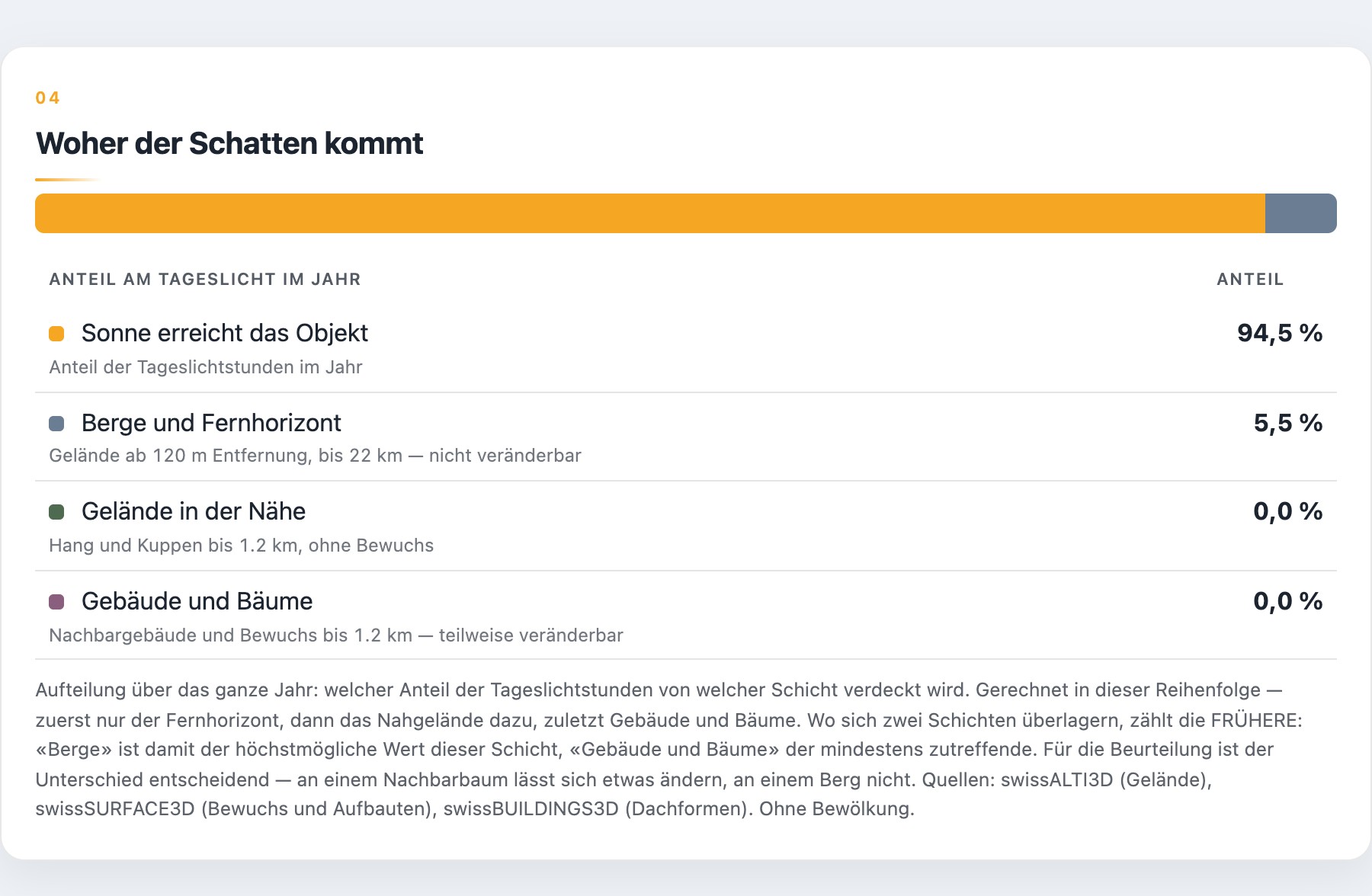
Hours of sunshine calculated geometrically, without clouds. The report is not an expert appraisal. Planned buildings are not included.
Contract and law: what protects you
Reservation: no obligation to buy without notarisation
If a reservation agreement obliges you to buy, it is a preliminary contract. Without public notarisation it is void (Art. 216 para. 2 of the Code of Obligations, CO), and as a rule you can reclaim a reservation payment. However, an agreement can be valid, even as a flat fee, if it only reimburses the seller for costs incurred in reliance on the sale (Federal Supreme Court 4A_109/2018). A court can reduce an excessive flat fee (BGE 140 III 200). Only pay into a notary’s account or an escrow account, and do not accept any clause under which the money is forfeited.
Purchase contract and land register
The purchase contract must be publicly notarised (Art. 216 of the Code of Obligations, CO). You only become the owner when you are entered in the land register (Art. 656 CC). Your bank pays the purchase price concurrently with the application to the land registry office, based on an irrevocable payment undertaking. Down payments made before ownership is transferred are usually lost if the seller goes bankrupt.
In the contract, check the handover date (when benefit and risk pass to you), the warranty, existing leases, the securing of the property gains tax, the accessories and the settlement of ancillary costs and the renovation fund.
Warranty: new rules since 1 January 2026
For existing properties, sellers usually exclude the warranty. This does not apply if the seller fraudulently concealed a defect (Art. 199 CO), nor to defects that lie completely outside what you could reasonably have expected and that significantly impair the purpose of the purchase. Since 1 January 2026, Art. 219a CO has also applied to property purchases:
- The deadline for notifying defects is 60 days. You notify hidden defects within 60 days of discovering them. Shorter deadlines in the contract are invalid.
- Your claims become time-barred five years after you acquire ownership. This period may not be shortened to your detriment.
- For new buildings that are still to be built or were completed less than two years before the sale, you can demand that defects be remedied free of charge. This right cannot be excluded in advance.
The new rules mainly concern contracts concluded from 1 January 2026. Always notify defects in writing and in a way you can prove.
New builds and buying off-plan
- Construction lien (Bauhandwerkerpfandrecht): Tradespeople and subcontractors who have not been paid can have a lien on your property registered within four months of completing their work, even if you have already paid the purchase price (Art. 837 ff. CC). You can protect yourself by checking the land register shortly before the transfer, with proof of payment, a retention or a bank guarantee.
- Advance payments: only against a bank guarantee or a joint and several guarantee.
- Condominium ownership off-plan: It can be established even before construction. Have your share transferred to you as early as possible.
Lien for the seller’s taxes
In many cantons, the property is subject to a statutory lien for the seller’s property gains tax (Art. 836 CC). If the seller does not pay, it falls on you. It is therefore common for part of the purchase price to go directly to the tax office or to be secured. Make sure this is stated in the contract.
Land register extract and easements
The land register extract shows ownership, easements such as rights of way, rights to build closer to the boundary or building restrictions, as well as land charges, liens, priority notices and annotations. Also read the contracts for the easements, because the exact content is what counts. A lease entered as a priority notice remains in force. Without a priority notice, you can terminate the lease if you urgently need the property for yourself. Usufruct and rights of residence also remain in place after the sale.
Condominium ownership
- The ownership quota (Wertquote) determines voting weight and share of costs.
- Check the regulations, the minutes of recent years, the budget and the balance of the renovation fund. A fund is not required by law.
- The community can have a lien registered in the land register for contributions from the last three years. This means unpaid contributions from the seller can fall on you, so ask for a confirmation.
- Resolutions already passed, for example on a renovation, are binding on you too.
- In May 2026, the Federal Council presented a revision of the law on condominium ownership. Parliament has not yet decided.
Building lease (Baurecht)
With a building lease, you buy the house but not the land. You pay ground rent, which is often linked to inflation or the mortgage rate. When the lease expires, usually after 30 to 100 years, the building reverts to the landowner in return for compensation. Pay attention to the remaining term, ground rent adjustments and the reversion compensation. They affect financing and resale.
Purchases by people from abroad
EU and EFTA nationals resident in Switzerland and people with a C permit can buy without authorisation. Nationals of other countries with a B permit may buy a main residence at their place of residence and live in it themselves (Lex Koller). The Federal Council wants to tighten the rules; the consultation ran until July 2026. Until Parliament decides, current law applies.
Estate agents, bidding processes and auctions
In Switzerland, the estate agent’s commission is usually paid by the seller, often 2 to 3% of the price. In a bidding process, bids are not binding until notarisation, and the seller does not have to accept the highest. In a foreclosure auction, you buy without warranty and take on the encumbrances according to the list of encumbrances. Bids are unconditional, so your financing must be in place beforehand.
Frequently asked questions
How much equity do I need to buy a house?
As a rule, at least 20% of the lending value, with at least 10% not coming from your pension fund (2nd pillar). On top of that come the purchase costs, from under 1% to around 4.5% of the purchase price depending on the canton. For a house costing CHF 1 million, that means at least CHF 200,000 plus purchase costs.
How much do I need to earn to buy a house for CHF 1 million?
With 20% equity and the banks’ usual assumptions (5% imputed interest rate, 1% maintenance, amortisation down to two thirds within 15 years), around CHF 177,000 gross per year. If the bank calculates with 4.5% interest, it is around CHF 165,000. More equity lowers the amount.
How high are the purchase costs in Switzerland?
Usually between under 1% in cantons without a property transfer tax, such as Zurich, Zug or Schwyz, and around 4.5% of the purchase price. They consist of the property transfer tax, notary and land register fees and the costs of mortgage notes (Schuldbriefe). The bank does not finance them.
Can I use money from my pension fund (2nd pillar) to buy a house?
Yes, for owner-occupied property, as an early withdrawal (at least CHF 20,000, at most every five years) or by pledging, up to three years before you become entitled to retirement benefits. However, the money does not count towards the minimum 10% of hard equity. An early withdrawal is taxed immediately and reduces your benefits.
What changes with the abolition of the imputed rental value?
From 1 January 2029, you no longer pay tax on an imputed rental value (Eigenmietwert) for the home you live in. At the same time, you can no longer deduct debt interest and maintenance costs for it. First-time buyers get a temporary deduction: in the first year up to CHF 10,000 for married couples or CHF 5,000 for everyone else, then 10% of the initial amount less each year.
Is a reservation agreement binding?
Without public notarisation it does not oblige you to buy; only the notarised purchase contract does. As a rule, you can reclaim a reservation payment. However, an agreement that only reimburses the seller for costs incurred in reliance on the sale can be valid.
Fixed-rate or SARON mortgage?
A fixed-rate mortgage gives you predictable costs over the entire term. A SARON mortgage is currently cheaper: SARON is just below 0% (−0.04% on 24 September 2026), and many banks then apply 0%. In practice, you only pay the margin. However, the rate on a SARON mortgage can rise at any time. What matters is how much of an interest rate rise your budget can cope with.
Which defects do I have to report after the purchase, and by when?
Since 1 January 2026, a 60-day deadline for notifying defects has applied to property purchases. You report hidden defects within 60 days of discovering them. Shorter deadlines in the contract are invalid. Claims become time-barred five years after you acquire ownership.
How do I find out how much sun a house gets in winter?
What matters is the position of the sun in December above the actual horizon at the address, with mountains, neighbouring buildings and trees. You can view the property in winter or have it calculated. The SunPlot report shows the hours of sunshine on every day of the year for addresses throughout Switzerland, calculated geometrically without clouds, and the shadow at every hour.
Do I need an expert for the viewing?
For existing properties it makes sense, because the warranty is usually excluded. At the Aargau Homeowners’ Association (HEV Aargau), for example, a pre-purchase building assessment costs CHF 200 to 240 per hour, plus VAT.
Sources
All information checked on 25 September 2026. Legal articles as per the version on fedlex.admin.ch.
Financing
- Swiss Bankers Association: Minimum requirements for mortgage financing, version of 13 December 2023, in force since 1 January 2025
- Swiss Bankers Association: Guidelines on mortgage-backed loans, 13 December 2023
- FINMA Guidance 02/2025 on affordability, 22 May 2025
- FSIO: Home ownership promotion using occupational pension funds; Federal Act on Occupational Pensions (BVG/LPP), Art. 30b to 30f; WEFV (ordinance on home ownership promotion)
- FSIO: The third pillar; FSIO: Buy-ins to pillar 3a; FTA: Circular No. 18a on pillar 3a, 22 December 2025
Interest rates and market
- SNB: Monetary policy assessment, 24 September 2026; SNB: SARON, as at 24 September 2026
- FOH: Reference mortgage interest rate
- FSO: Residential property price index, Q2 2026, 30 July 2026
- FSO: Vacant dwellings census 2026, 10 September 2026
- UBS: Real Estate Focus 2026, 26 March 2026; UBS: Affordability by municipality, 7 May 2026
- ZKB: Interest rate forecasts and UBS: Interest rate forecasts, as of 24 September 2026
- Interest rates: MoneyPark and Helvetia, 21 September 2026; RealAdvisor, 24 September 2026; hypotheke.ch, 23 and 25 September 2026; SNB interest rate statistics
Costs and taxes
- Federal Council: Reform of residential property taxation from 1 January 2029, 1 April 2026
- FDF: Fact sheet on debt interest and the first-time buyer deduction, 15 August 2025
- Property transfer tax: cantonal tax and fee legislation, as of 1 January 2026, e.g. Bern, Lucerne, Basel-Stadt, Basel-Landschaft, Jura; Zurich notaries’ offices: fees
- HEV Schweiz: Housing costs; VKG: Cantonal building insurers
Law
- Federal Council: New law on construction defects from 1 January 2026, 30 April 2025; Code of Obligations, Civil Code
- Federal Supreme Court: BGE 140 III 200 and judgment 4A_109/2018 on the reservation agreement; BGE 126 III 452 on the deprivation of light and sun
- Federal Office of Justice: Revision of the Lex Koller; Revision of condominium ownership law, 13 May 2026
Property and location
- FOPH: Radon map; Low-Voltage Installation Ordinance; Suva: Asbestos
- EnDK: MuKEn 2025; SwissEnergy: Replacing your heating system; GEAK; Buildings Programme: GEAK Plus; Canton of Fribourg: GEAK; Canton of Vaud: CECB; HEV Aargau: Building advice
- PLR cadastre; map.geo.admin.ch; Amtsblattportal (official gazettes); FTA tax calculator
- FOEN: Noise pollution; FOEN: Hazard maps; SVV and VKG: Surface runoff, 18 August 2026
Sun and shadow
- SNV: SN EN 17037 Daylight in buildings
- Canton of Zurich: Shadow cast by high-rise buildings (§ 30 ABV); Bern: Art. 22 BauV; Lucerne: § 152 PBG; Zurich: § 169 ff. EG ZGB
- Fleming, Grimes, Lebreton, Maré, Nunns (2018): Valuing sunshine; Helbich et al. (2013), Vienna; Bilanz: Lake views and prices, 4 May 2026
- Sun position: our own calculation using standard astronomical formulas
Before you make an offer: check the location
Sun over the year, shadow at every hour, noise and natural hazards for one address, from official data. Single report CHF 49 (introductory price), link usually within 24 hours.
This guide is no substitute for financial, tax or legal advice. Interest rates, laws and bank practice change. All information and calculator results without guarantee, as of 25 September 2026. Published by SunPlot Switzerland.