When a new building casts shadow
Whether a building next door shades your flat depends on direction, height and distance, and on the season. A new building to the north hardly takes any sun from you, at most early in the morning or late in the evening in summer, when the sun rises in the north-east and sets in the north-west. A new building to the south, south-east or south-west affects you mainly in winter, when the sun is low. A new building to the west takes the evening sun, one to the east the morning sun.
Example: a new 15-metre apartment building casts a shadow of around 42 metres at midday in winter. In the morning and evening, when the sun is even lower, considerably more. If your balcony is 20 metres to the north of it and lower than around 8 metres, it is in shadow around midday in December.
How to read building profiles and planning applications
- Building profiles (Baugespann): the poles with battens show the corners and height of the planned building. From your balcony you can see where the edge will be.
- Planning application: during the public display period, the plans are available at the municipality. They state the building height, floor plan and distance. Anyone affected can lodge an objection within the display period. Which deadlines and conditions apply is governed by cantonal building law.
- Shadow diagram: for high-rise buildings, cantons require proof of the cast shadows. In the canton of Zurich, high-rise buildings may not shade inhabited buildings in residential zones for longer than three hours on the average winter days. For ordinary residential buildings, this proof is usually not required. In that case, the boundary distances and building heights of the building regulations apply.
Recording the current situation
Anyone who later discusses sun and view needs the current situation as a snapshot: how many hours of sunshine the flat has today, when the sun comes in winter, what you can see from the terrace. Photos from the balcony help, but depend on the weather and the time of day.
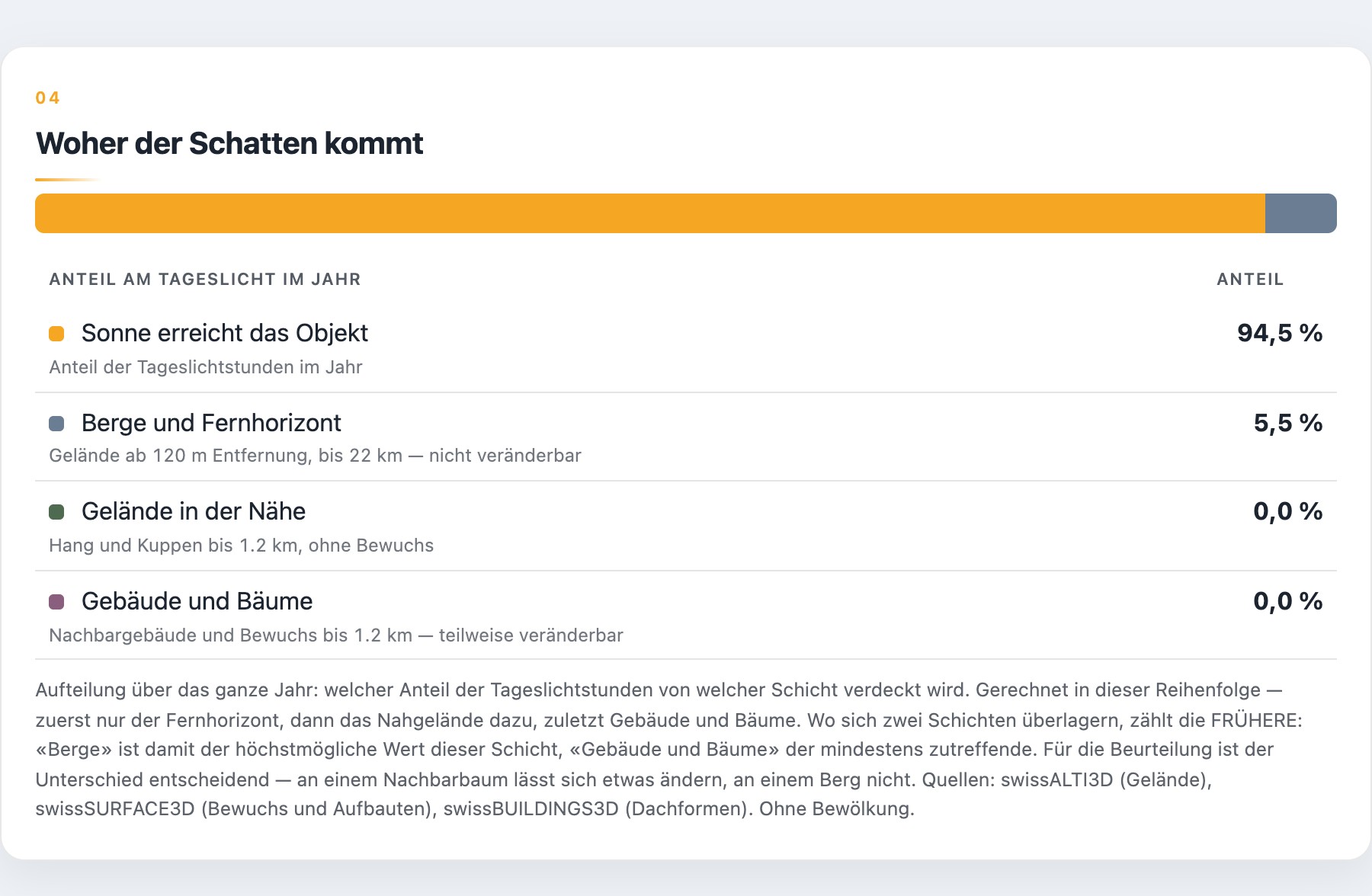
A SunPlot report records the situation using the official 3D data: hours of sunshine for every day of the year, the cast shadows at any time of day, the view from every façade. And it shows from which direction and at which times of day the sun comes. So you can see straight away whether a new building at the planned location falls into the sun path at all.
What the report can and cannot do
- It shows the existing situation from the Confederation’s official building and terrain data.
- Planned buildings that have not yet been built are not included. The report is not a shadow diagram and not official proof for a planning application.
- It answers the preliminary question: when and from which direction do I get sun today, and how much of it is at stake?
Short answers
How much shadow does a new building next door cast?
At midday on 21 December, the shadow on the Swiss Plateau is around 2.8 times as long as the building is high; on 21 June only around 0.44 times. So in winter a 15-metre building shades around 42 metres, in summer around 7 metres. You are affected if the building stands to the south, south-east or south-west.
Does SunPlot show the shadow of a planned new building?
No. The report shows the existing situation from the official 3D data. Planned buildings are not included. But it does show when and from which direction the sun comes today, and records the current situation as a snapshot.
What are building profiles (Baugespann)?
Building profiles (Baugespann, also called Bauprofile) are the wooden poles with battens on a plot. They mark the corners and the height of the planned building while the planning application is on public display.