The twelve points
- 1. Winter sun. In summer the sun reaches almost everywhere. What matters is 21 December: is the sun still above the neighbouring house and the slope at midday? Hours of sunshine for every day of the year show it.
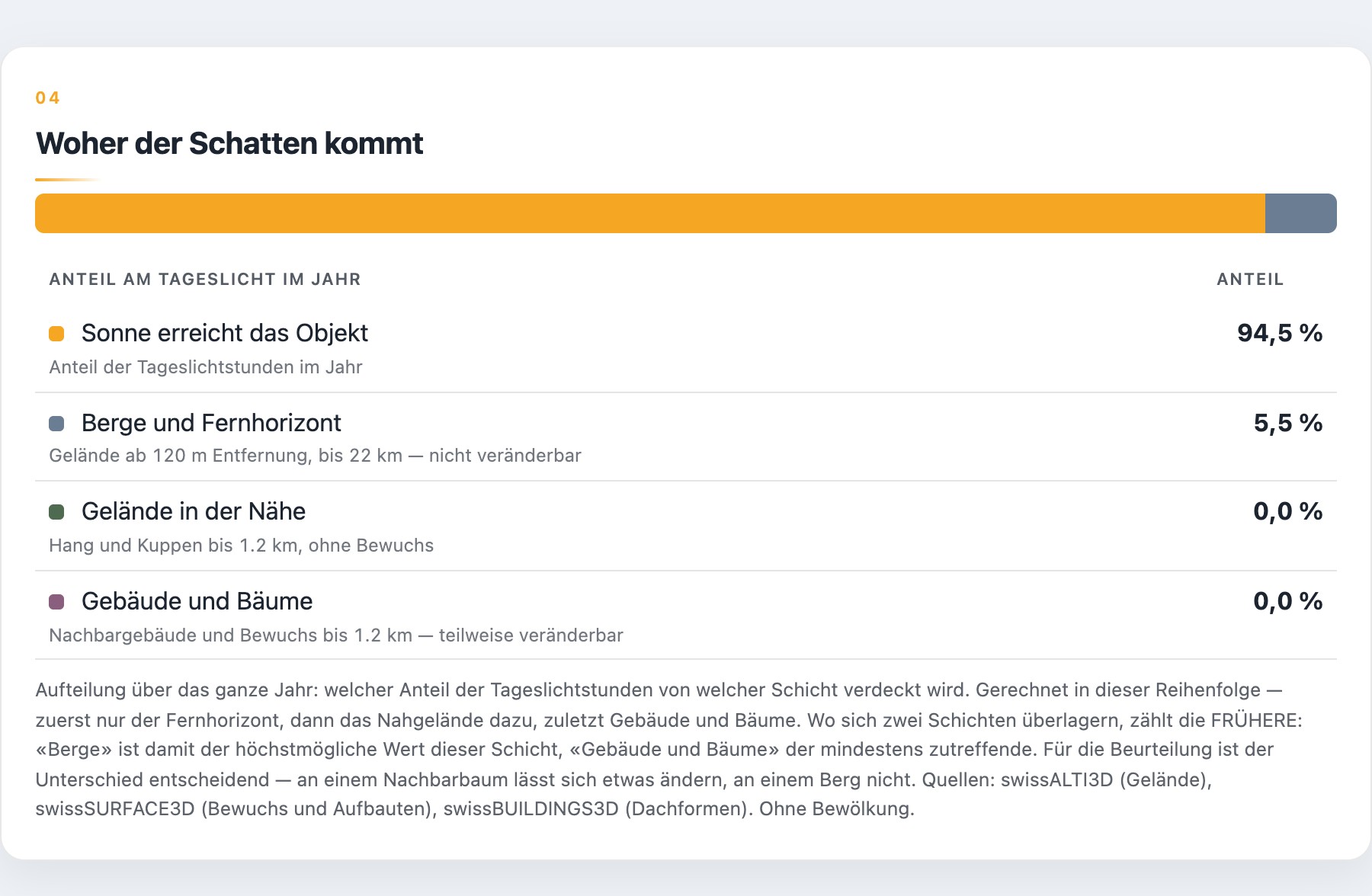
- 2. Where the shadow comes from. A tree can be felled, a mountain cannot. The share of mountains, terrain, buildings and trees in the shadow tells you whether anything can be changed.
- 3. Today’s view. The panoramic view from every façade and floor with the mountains, and what the neighbour blocks of it.
- 4. Tomorrow’s view. The building zone of the plot opposite. A residential zone means building land in waiting. Current planning applications are in the official gazette.
- 5. Noise at night. The federal noise maps for road, railway and aircraft, compared with the limit value for the zone. The night is what counts, not the Saturday afternoon of the viewing.
- 6. Natural hazards. Flooding, landslides, rockfall and avalanches from the canton’s hazard map. Red and blue usually mean conditions up to a building ban; the information from the municipality is decisive.
- 7. Surface runoff. Where heavy rain flows over the terrain, even without a stream. An issue for cellars, garages and light wells.
- 8. Groundwater and ground. How high the groundwater is and whether a borehole heat exchanger is possible. Relevant for heating and the cellar.
- 9. Solar. The federal sonnendach.ch data for the roof surfaces, with the shading from the surroundings. For owners, a cost factor over decades.
- 10. Public transport. Quality class and nearest stop. Decides whether you need a second car.
- 11. School, shops, doctor. Everyday routes with distances. As the crow flies is not the same as on foot, so walk them at the viewing.
- 12. Accident spots and air. Accidents with personal injury nearby, nitrogen dioxide and particulate matter at the location.
How to work through the list
All twelve points can be checked from official data before you set foot in the house. SunPlot brings them together in one report for the address: sun and shadow in 3D, view, and all maps at the property. With the report, you go into the viewing differently. Instead of “nice location”, you ask: why is the seating area in shadow from 14:00 in December? What is planned for the meadow opposite? Why is the house in the yellow flood zone?
What the list does not cover
- The condition of the house: roof, façade, pipes, heating, damp. That is what a building expert is for.
- The price: whether it matches the market is something a valuation will tell you.
- The law: land register, easements, the municipality’s building law.
Short answers
What should I check about the location before buying a house?
Winter sun and sources of shadow, today’s view and the building zone opposite, noise at night, natural hazards and surface runoff, groundwater, solar potential, public transport, everyday routes as well as accident spots and air quality. All of it can be checked from official data for every Swiss address.
How can I tell whether a house gets sun in winter?
With a calculation of the sun’s position above the real horizon of the address, including mountains, neighbouring houses and trees. SunPlot shows the hours of sunshine for every day of the year and the cast shadows on 21 December in 3D.
How do I know whether something will be built opposite?
From the building zone of the plot: residential and mixed zones are building land, agricultural zones usually remain free. Specific planning applications are published in the municipality’s official gazette and are available for inspection at the building authority.