Why noise is the most common annoyance after moving in
You can’t see noise, and you often can’t hear it during the viewing: it takes place in the afternoon or on a Saturday, when the street is quiet. The trouble comes later, on the first night with the window open or on the first Monday morning at six. Unlike a dark kitchen, noise can’t be fixed with furniture either. That’s why it pays to check it before you sign.
What the figures mean
Noise is measured in decibels (dB). The scale is logarithmic: most people perceive a difference of around 10 dB as twice as loud. A value on its own therefore says little; what matters is the comparison with the legal standard. The federal Noise Abatement Ordinance (NAO) assigns every property to a sensitivity level and sets immission limits for day and night.
Pure recreation zones fall under level I with 55 / 45 dB, industrial zones under level IV with 70 / 60 dB. For new buildings and newly developed areas, the planning value applies, which is 5 dB lower in each case. Which level applies to an address is shown in the cantonal cadastre of public-law restrictions on landownership (PLR cadastre).
Where the values come from
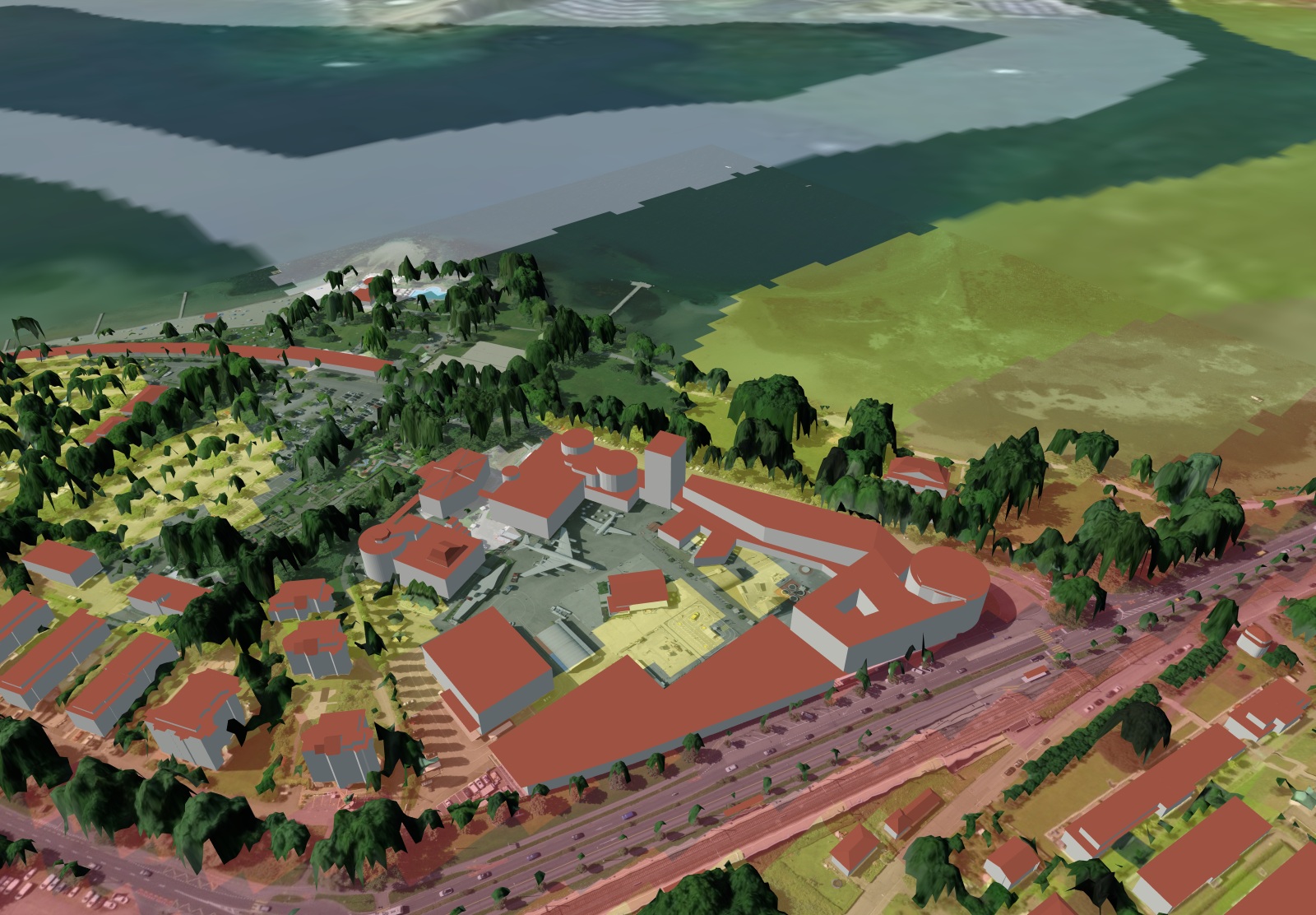
The Federal Office for the Environment (FOEN) maintains noise maps for road, railway and aircraft noise for the whole of Switzerland, separately for day and night. SunPlot uses the road and railway noise from these; aircraft noise is not part of the report. The maps are calculated from traffic volumes, speed, road surface and terrain, not measured, and apply to the façade. Inside, it is considerably quieter with the window closed; with the window open, the noise comes in at roughly the level shown on the map.
How to check it yourself
- Listen at the critical time: on a weekday, stand on the street in front of the building at 7:00 and at 17:00, and once after 22:00. On a Sunday almost every street is quiet.
- Find all the sources: main road, railway line, motorway in the valley, flight path, but also restaurant, bar, school playground, church, businesses and ventilation units on neighbouring roofs.
- Courtyard or street: ask which side the bedroom faces. On the same street, a flat with its bedroom facing the courtyard is often the better choice.
- Windows and shutters: soundproof windows are common in buildings on noisy streets. They help as long as they are closed.
- Look at the noise map: the level at the building by day and night, compared with the limit for its sensitivity level. Then you know whether your Sunday impression is misleading.
What the report shows
- Road and railway noise for day and night as a map over the 3D model, with the value at the building.
- The Noise Abatement Ordinance limit for the sensitivity level of the address alongside, with an assessment.
- Plus air quality, road accidents, public transport, surroundings and the sun for your floor, all for the same address.
Short answers
At what decibel level is a flat too noisy?
The deciding factor is the immission limit of the Noise Abatement Ordinance for the sensitivity level of the property. In a residential zone (level II), that is 60 dB during the day and 50 dB at night; in a mixed zone (level III), 65 and 55 dB. Values above that are considered excessive.
Where can I see the noise for an address?
In the noise maps of the Federal Office for the Environment, which show road and railway noise for day and night. SunPlot lays these maps over the 3D model of the address and gives the value at the building with the limit next to it.
Are the noise maps measured?
No, they are calculated from traffic volume, speed, road surface and terrain, according to federal guidelines. They apply to the façade, not to the interior. Short-term noise such as a building site or a festival is not included.