Why sun and shadow cannot be estimated
In the Swiss Plateau, the sun stands around 20 degrees above the horizon at noon on 21 December, and around 66 degrees on 21 June. In summer, it shines over almost every obstacle; in winter, the same obstacle casts a shadow almost three times as long as it is tall. Whether a balcony gets sun in January therefore depends on things no compass shows: the building opposite, the slope behind it, the row of trees in front and the mountain on the horizon.
How the calculation works
SunPlot builds the surroundings of an address in 3D from Switzerland’s official data: the terrain and the mountains from swisstopo’s elevation model, the neighbouring buildings with roof shapes from swissBUILDINGS3D, the trees from the laser point cloud. Then, every 10 minutes throughout the year, it checks whether the sun reaches the measuring point: on the roof ridge of the house, on the balcony or at the spot in the garden that you choose.
What the report shows
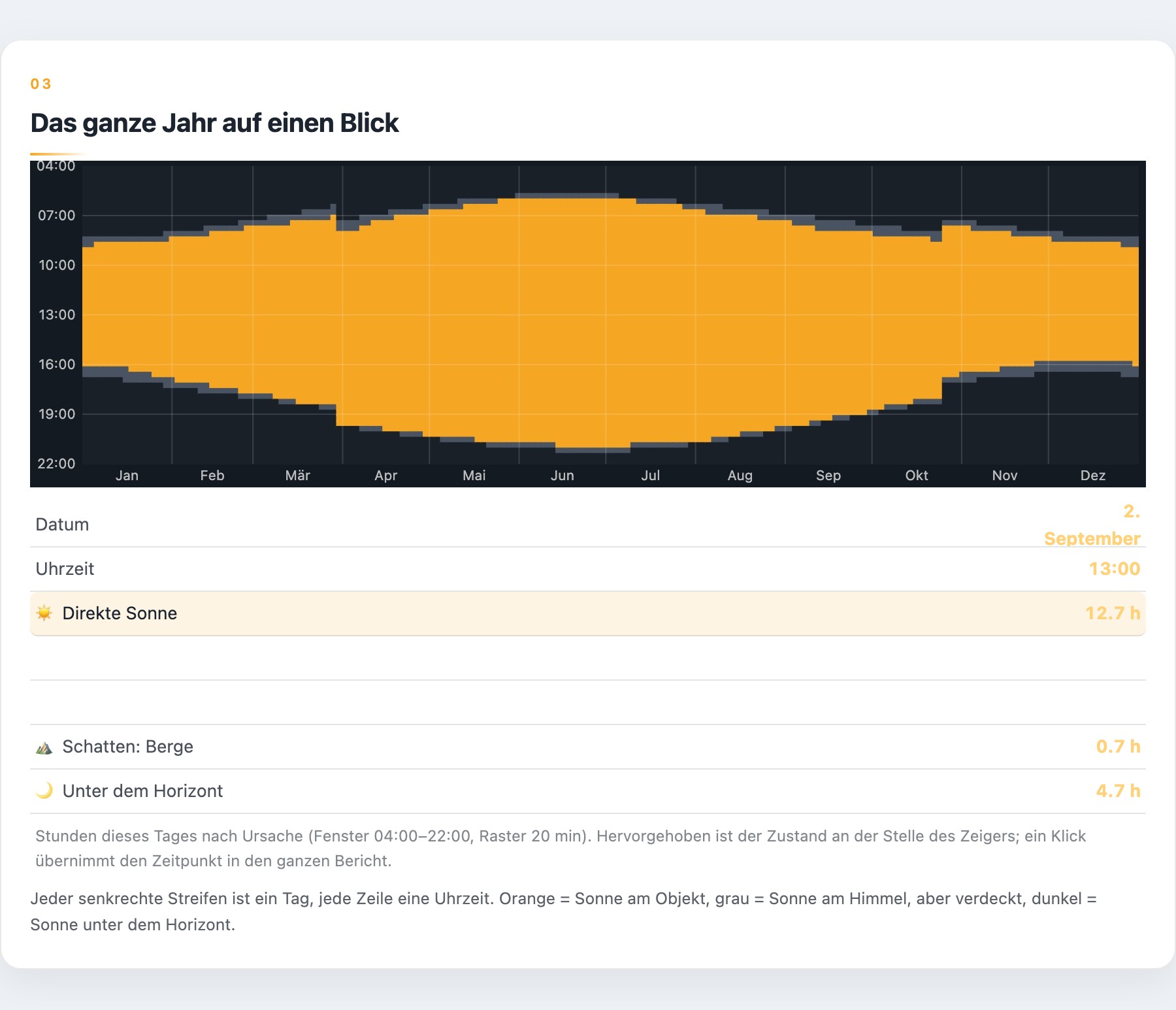
- Hours of sunshine per day, on the reference dates 21 December and 21 June, and throughout the year.
- Where the shadow comes from: the share of mountains, terrain, buildings and trees.
- Shadow casting in 3D at any time and on any date you choose.
- Shadow-hours map around the house: the sunniest spot for a seating area, terrace or garden.
Sun and shadow depending on your question
- Buying or renting a flat: winter sun in the living room, evening sun on the balcony. How much sun does my flat get?
- Balcony, terrace, garden: When does the evening sun arrive, and when does it go? Evening sun on balconies and terraces
- New building next door: How much sun is at stake? Shadow from the neighbouring building
- Building and planning: Terms and rules. Shadow diagram and 2-hour shadow
- Whole municipality: Where the winter sun stays behind the mountain. Sun by place
Short answers
How do I check how much sun an address gets?
With a calculation from 3D data: terrain, mountains, neighbouring buildings and trees. SunPlot calculates the sun’s position every 10 minutes throughout the year and shows hours of sunshine per day, the annual overview and the cast shadows in 3D. Entering the address is all it takes.
Are trees and neighbouring buildings taken into account in the shadows?
Yes. The neighbouring buildings come from swissBUILDINGS3D with roof shapes, the trees from the swissSURFACE3D laser point cloud, both from swisstopo and available throughout Switzerland.
What is the difference between hours of sunshine and sunshine duration?
At SunPlot, hours of sunshine are the time during which the sun is above the horizon and not hidden by a mountain, building or tree, without clouds. MeteoSwiss sunshine duration is a climate value that includes the weather. Both are in the report.